
Last updated September 25, 2026
How to Hire an ADU Contractor in Lancaster: A Step-by-Step Guide
California’s contractor license lookup will tell you if a license is active. It will not tell you if that contractor has ever pulled an ADU permit in Lancaster, whether their bid includes engineered drawings, or who pays when the building department rejects the plan set. After 900 ADUs across the state, we’ve watched the same failure pattern repeat: the homeowner hires a designer, then bids the plans to three builders, and discovers at plan check that the drawings don’t match Lancaster’s specific interpretation of the state’s ADU code. The designer blames the builder. The builder blames the designer. The homeowner pays for corrections neither party will own. This guide - alongside our ADU Design & Permitting Maintenance Checklist for Lancaster Homeowners - explains how to hire an ADU contractor in Lancaster without stepping into that liability gap.
Quick Answer
Hiring an ADU contractor in Lancaster starts with choosing your contract structure before you review a single portfolio. Design-build - one entity responsible for drawings, permits, and construction under a single written price - eliminates the designer-builder blame gap that causes most cost overruns. Verify permit history through LA County’s public portal, demand line-item pricing that includes soils, utility trenching, fire sprinklers, and Title 24 compliance, and sign only a fixed-price contract tied to stamped drawings with defined change-order triggers.
Table of Contents
- The Three Contract Structures and Where Liability Hides
- How to Verify a Contractor’s Real ADU Permit History in Lancaster
- Line Items Routinely Omitted from Antelope Valley ADU Bids
- Interview Questions That Separate Experienced Contractors from Pretenders
- What a Written Fixed-Price Contract Must Include
- Lancaster-Specific Code and Climate Considerations
- Common Mistakes to Avoid
- When to Call a Professional
- Frequently Asked Questions
The Three Contract Structures and Where Liability Hides
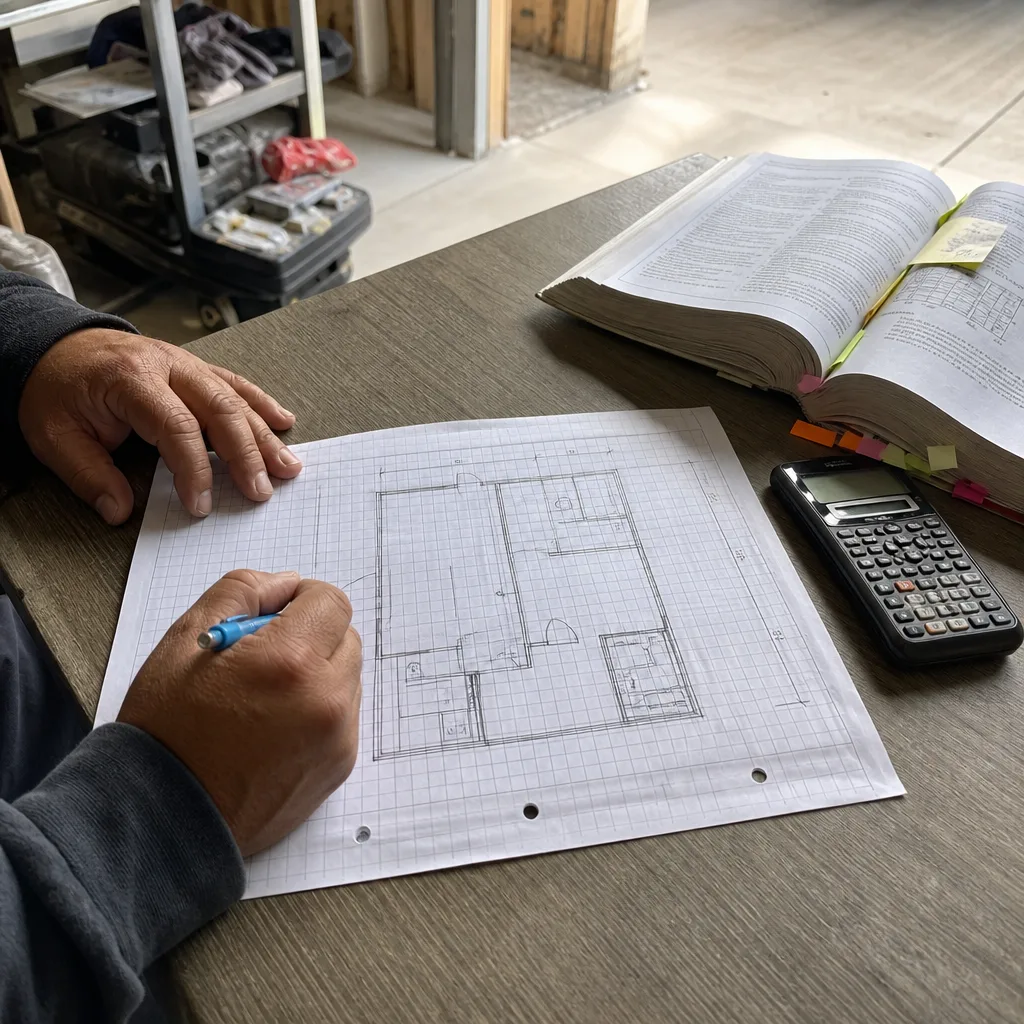
Most Lancaster homeowners assume the contractor’s license classification matters most. It doesn’t. The contract structure matters more. Here’s how the three common models actually work when a plan set hits Lancaster’s plan check desk.
Design-Then-Bid (The Highest-Risk Model)
You hire an architect or designer to produce drawings. You then request bids from two to four contractors. The designer’s contract ends at permit approval - or sometimes at drawing delivery. The contractor’s bid assumes the drawings are buildable and permit-ready.
The liability gap: When Lancaster’s plan checker flags a fire separation detail or requests a soils report the designer didn’t anticipate, the contractor’s bid is suddenly wrong. The contractor claims “unforeseen conditions.” The designer claims “the builder should have caught that.” You pay for the correction while both parties point at each other.
We’ve reviewed hundreds of stalled Lancaster projects that started this way. The average correction cost runs $8,000-$18,000, and the delay adds three to six months.
Owner-Managed (The Highest-Effort Model)
You serve as your own general contractor, hiring designer, structural engineer, MEP engineer, and trades directly. You pull permits in your own name. You coordinate inspections.
The liability gap: In Lancaster, owner-managed ADUs fail most often at the inspection milestone. The electrician’s work passes, but the inspector notes that the HVAC rough-in conflicts with the Title 24 ventilation plan. The HVAC contractor and electrician each claim the other read the drawings wrong. You, as the permit holder, are legally responsible for the correction. The city does not mediate between your trades.
This model saves money only if nothing goes wrong. In our experience, something goes wrong on most Lancaster ADUs involving utility trenching across the Antelope Valley’s expansive lots or fire sprinkler integration with older single-story homes.
Design-Build (The Single-Point Accountability Model)
One entity produces the drawings, pulls permits, and builds the project under one contract at one written price. Ellery ADU Studio Lancaster home operates this way. The permit set is treated as the core product, not an afterthought, because the same team that drew the plans must build from them.
The liability gap: There isn’t one. If Lancaster’s plan checker requests corrections, the design-build firm absorbs the resubmittal cost. If the built condition doesn’t match the permitted drawings, the firm corrects it. Under our Haven Standard, Clause 5 (No Surprises), the scope is locked at signing; no door-side upsells, no scope creep.
Design-build isn’t faster because we rush. It’s faster because we eliminate the coordination failure between separate parties.
How to Verify a Contractor’s Real ADU Permit History in Lancaster
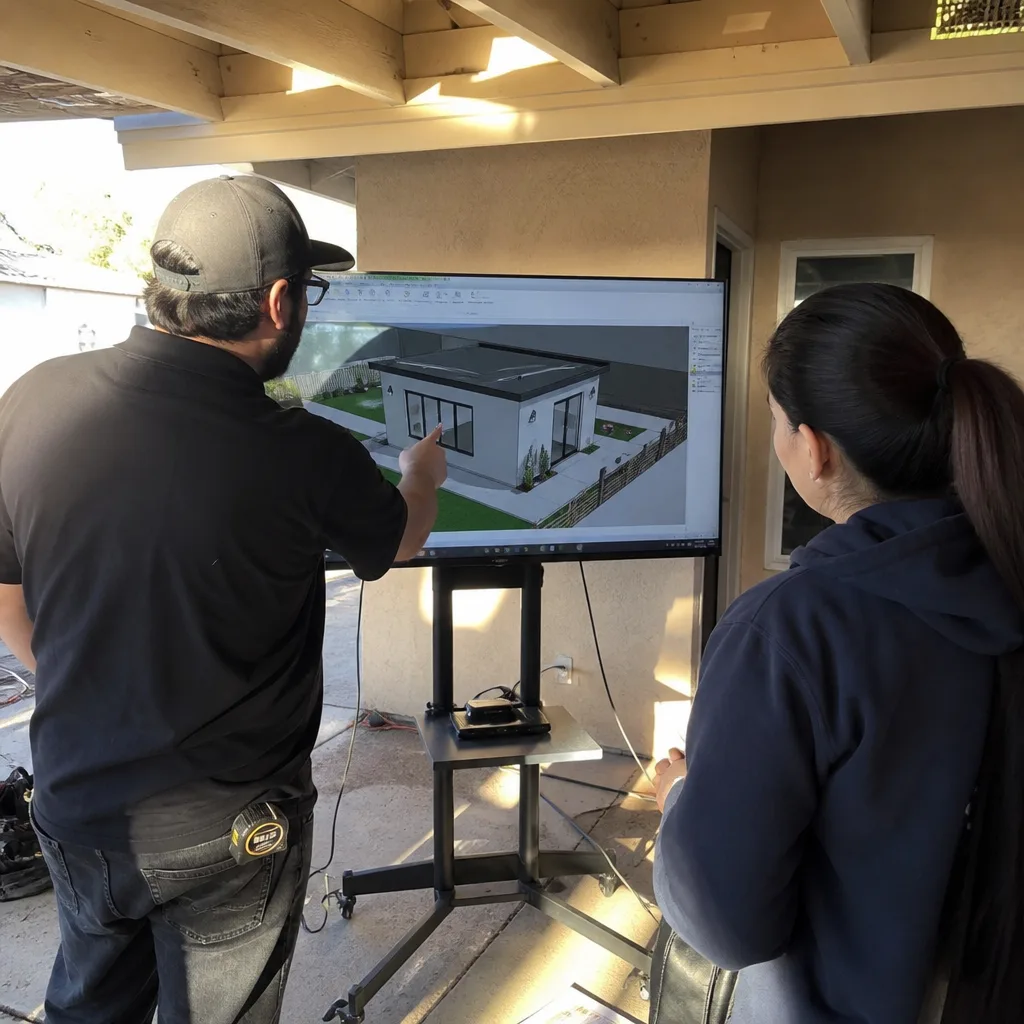
California’s Contractors State License Board (CSLB) lookup shows license status, bond, and workers’ compensation. It does not show permit history. A contractor can hold an active B-General license for twenty years without ever pulling an ADU permit in Lancaster. Here’s how to find what the CSLB won’t show you.
Step 1: Access LA County’s Public Permit Portal
- Navigate to the LA County Department of Regional Planning’s online permit search or the City of Lancaster’s building division portal if your property is within city limits.
- Search by contractor license number or business name. Use the exact legal entity name - many contractors operate under DBA names that don’t match their license.
- Filter for “ADU,” “accessory dwelling unit,” or “garage conversion” permit types from 2020 forward. California’s ADU law changed dramatically in 2020; prior permit history is less relevant.
Step 2: Read What the Results Actually Show
Zero ADU permits: This contractor has never navigated Lancaster’s specific plan check process. They may be skilled general builders. They are not proven ADU builders in this jurisdiction.
One ADU permit: Ask directly if the project completed. A single permit that was abandoned or failed inspection teaches different lessons than a completed project.
Multiple ADU permits with long gaps: Look at the issue dates. Permits clustered in 2020-2021 followed by silence may indicate the contractor struggled with the 2022 code updates or shifted to other work types.
Multiple completed ADUs with recent dates: This contractor knows Lancaster’s current plan check staff, correction patterns, and inspection timing.
Step 3: Cross-Reference with the Address
Drive the project addresses. Look for the completed ADU. If the contractor claims a Lancaster ADU completed in 2023, the structure should be visible from the street or alley. This verification takes thirty minutes and eliminates half of inflated portfolios.
At ADU Design & Permitting in Lancaster, our permit history is documented and address-verifiable. We don’t expect trust based on claims.
Line Items Routinely Omitted from Antelope Valley ADU Bids
Lancaster’s high desert location and LA County’s specific overlay codes create cost categories that contractors from coastal markets routinely miss. A bid that looks competitive often wins by omitting work that becomes your change order later. For a complete picture, see our ADU Cost Breakdown: The Lancaster Homeowner’s Reference for 2026; here’s what to demand in writing.
Soils Testing and Foundation Design
The Antelope Valley’s expansive clay soils and seasonal moisture variation require specific foundation design. A slab-on-grade bid without a geotechnical report is guessing. In our Lancaster projects, soils testing runs $2,800-$4,500, and engineered foundation adjustments add $3,000-$8,000 when clay expansion potential is present. A bid that says “standard slab” without referencing soils data is incomplete.
Utility Trenching Beyond 50 Feet
Lancaster’s lot sizes often exceed 7,500 square feet, and the main dwelling may sit 80-120 feet from the optimal ADU location. Utility trenching - water, sewer, electric, gas - is frequently bid at a “standard” distance with per-foot overage rates that triple the line item. Demand a trenching allowance with a defined linear footage and a per-foot rate beyond that threshold. On a recent Lancaster project near Avenue K, trenching ran 94 feet and added $6,200 to a bid that had assumed 50 feet.
Fire Sprinkler Systems
LA County requires fire sprinklers in ADUs when the total square footage of all structures on the property exceeds 150 percent of the original dwelling’s footprint. This triggers more often in Lancaster than homeowners expect because the original 1950s-1970s homes are small. A 1,200-square-foot original home with a 900-square-foot ADU and 400-square-foot garage addition hits the threshold. Sprinkler system design, installation, and inspection add $8,000-$14,000. Bids that omit this are common.
Title 24 Energy Compliance Documentation
Every ADU in Lancaster requires California Title 24 energy compliance documentation - the CF-1R and related forms. Some contractors treat this as “included in our process” without naming the energy consultant or the software (EnergyPro, CBECC-Res, or equivalent). If the compliance documentation fails at plan check, the project stalls. Demand the consultant’s name and a sample CF-1R from a completed project.
Summary Table: Hidden Cost Categories
| Line Item | Typical Lancaster Range | What Incomplete Bids Say |
|---|---|---|
| Soils testing & engineered foundation | $5,800-$12,500 | “Standard slab included” |
| Utility trenching (per foot over 50 ft) | $65-$95/linear foot | “Utilities included” |
| Fire sprinkler system | $8,000-$14,000 | “Per code requirements” |
| Title 24 compliance documentation | $1,200-$2,800 | “Energy compliance handled” |
At Ellery ADU Studio Lancaster, every project is quoted with these line items itemized before any work begins, per Haven Standard Clause 1: a written price before work starts, always.
Interview Questions That Separate Experienced Contractors from Pretenders
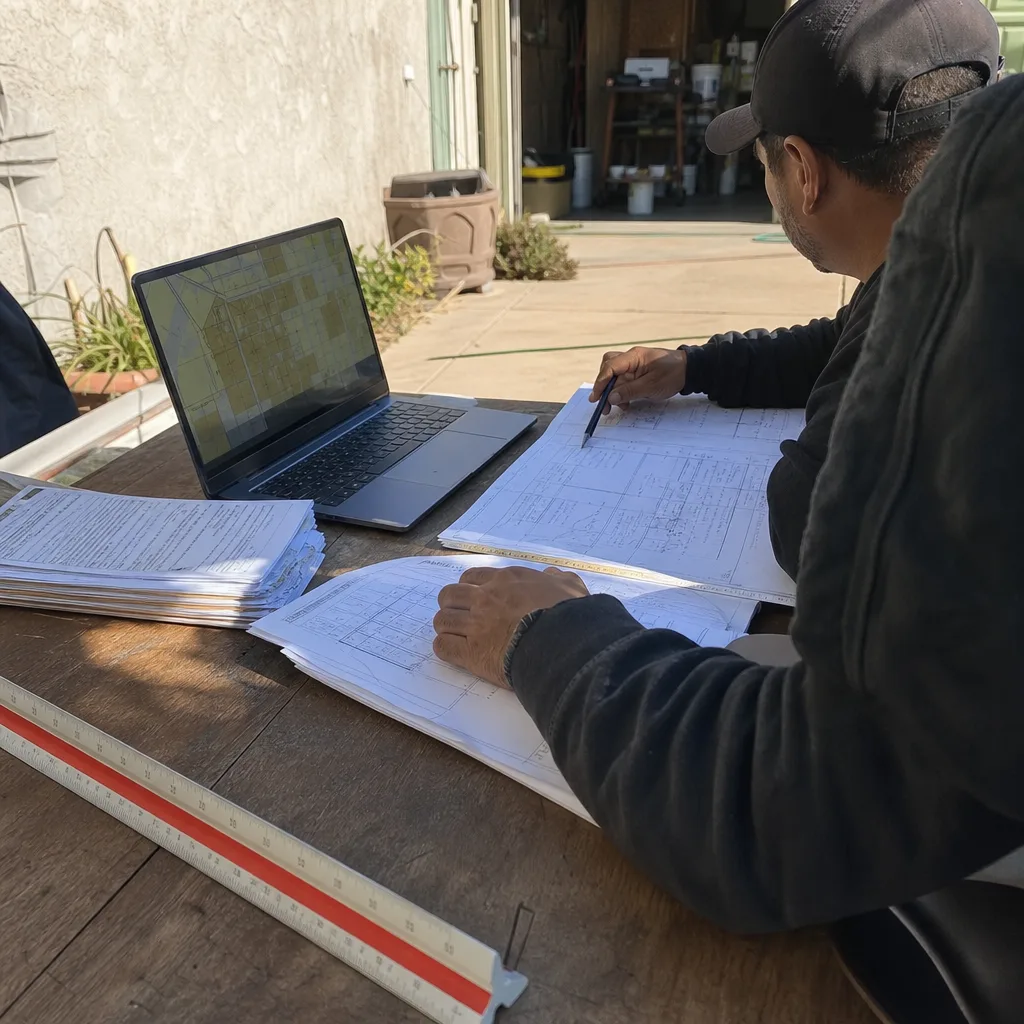
Generic questions produce generic answers. “Have you done ADUs before?” gets you “Yes, plenty.” These questions force specificity about Lancaster’s actual process.
Question 1: “Who was the plan checker you worked with on your last Lancaster ADU, and how many correction rounds did the plan set go through?”
A contractor who has actually navigated Lancaster’s plan check can name the staff member. They know whether corrections are typically structural, energy, or fire-related. They can describe the resubmittal timeline. A contractor who hedges - “it varies,” “the city assigns different people” - has not done enough Lancaster ADUs to know the patterns.
In our experience, Lancaster’s plan check for ADUs averages two to three correction rounds for owner-submitted plans and one to two rounds for design-build firms that pre-coordinate with the building department. The difference is not luck. It’s front-loaded drawing accuracy.
Question 2: “Who absorbed the cost of the last plan check correction you encountered?”
In a design-then-bid structure, the answer is almost always “the homeowner.” In design-build, the answer should be “we did.” If a contractor claims they’ve never had a correction, they are either inexperienced or dishonest. Plan check corrections are standard; the question is who pays.
Question 3: “Walk me through your Title 24 compliance process - who produces the documentation, what software, and when is it submitted relative to the structural set?”
The answer should name a specific energy consultant or in-house certifier, specific software, and a timeline. “We handle all that” without specifics means they subcontract to the lowest bidder at the last minute, a common failure point.
Question 4: “For a garage conversion on a 1970s Lancaster home, what is your process for assessing whether the existing slab meets current code for a dwelling unit?”
The correct answer involves a site visit with a laser level, core sampling or GPR (ground-penetrating radar) if cracks are present, and a structural engineer’s letter if the slab is below 4 inches or unreinforced. “We’ll look at it during construction” means they haven’t priced the potential foundation replacement.
Question 5: “Show me the last written fixed-price ADU contract you executed, with the client’s information redacted.”
This is the most revealing question. A contractor who cannot produce a sample contract within 48 hours does not routinely use fixed-price agreements. A contract that shows “allowances” for major categories - foundation, utilities, finishes - is not fixed-price. It’s a cost-plus contract with a ceiling that will be reached.
Our Haven Standard contracts are available for review before engagement, and you can find more guides & resources on our blog. Clause 1 is visible before you sign: written price before work starts.
What a Written Fixed-Price Contract Must Include
A “fixed price” claim is meaningless without specific contractual elements. Here’s what makes it enforceable in Lancaster’s jurisdiction.
Scope Definition Tied to Stamped Drawings
The contract must reference a specific permit set, stamped by a California-licensed architect or engineer, with a date and revision number. Vague language - “build ADU per plans” - fails when the plans change at plan check. The contract should state: “Construction shall conform to permit set dated [date], revision [number], as approved by [jurisdiction]. Deviations require written change order.”
Change-Order Trigger Language
The contract must define exactly what triggers a price change. Standard triggers: homeowner-requested scope changes, concealed conditions discovered after reasonable investigation (not visible conditions a site visit should have revealed), and code changes enacted after permit issuance. Everything else stays at the written price.
Haven Standard Clause 5 (No Surprises) states: “The scope is locked at signing. No door-side upsells. No scope creep. If we missed it in our site evaluation, we absorb it.”
Inspection Milestone Payment Schedule
Never pay more than 10 percent deposit plus incremental payments tied to passed inspections. A typical Lancaster ADU schedule:
- 10 percent at contract signing
- 25 percent at foundation/rough grading inspection pass
- 25 percent at framing/rough MEP inspection pass
- 25 percent at insulation/drywall inspection pass
- 15 percent at final inspection and certificate of occupancy
Contracts demanding 50 percent upfront or final payment before COO issuance create unrecoverable risk. We’ve seen Lancaster homeowners lose deposits to contractors who disappeared mid-project.
Written Warranty with Specific Duration and Coverage
Our 365-Day Done Right Promise is explicit: if the finished ADU is not built to the permitted drawings, we make it right - in writing, before the project starts. Any warranty shorter than one year or limited to “workmanship defects” without reference to the approved plans is inadequate for a six-figure project.
Lancaster-Specific Code and Climate Considerations
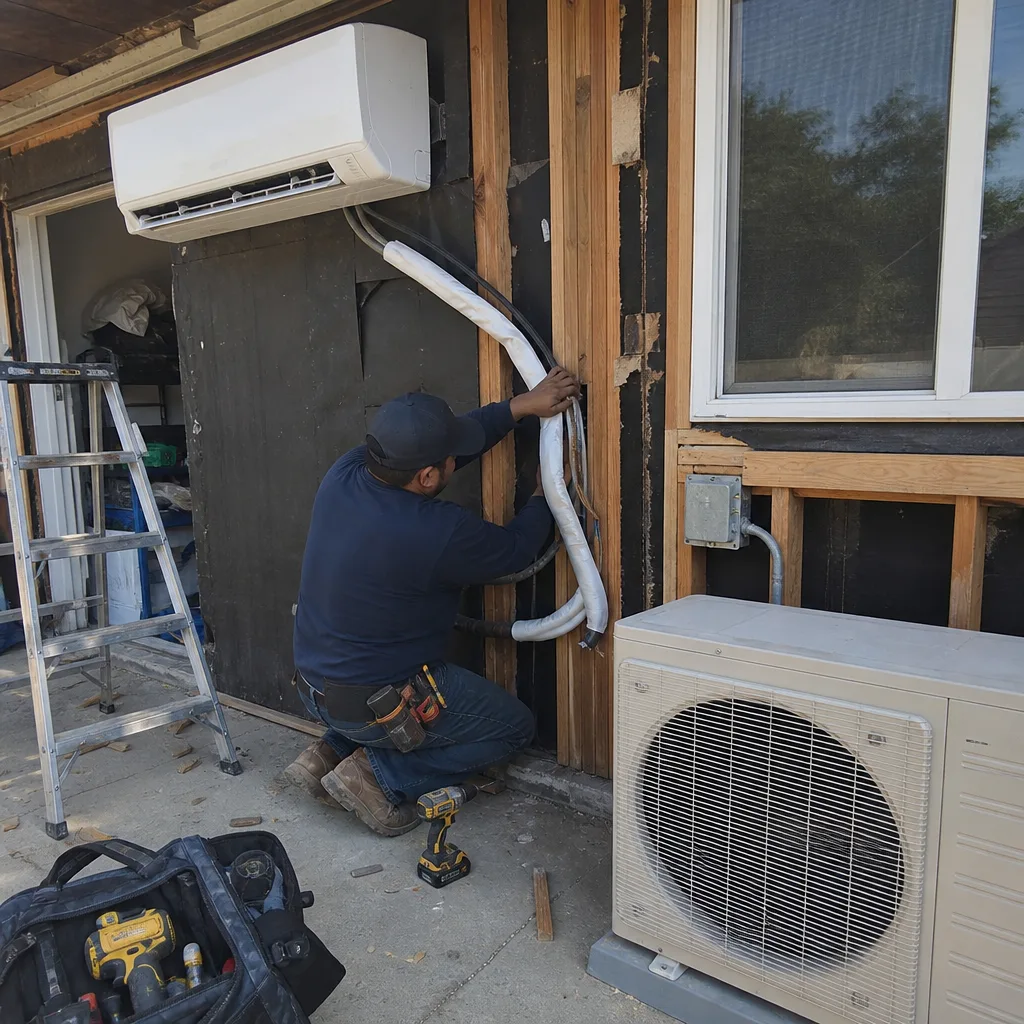
Lancaster’s location in the Antelope Valley creates conditions that coastal California contractors underestimate. These factors affect design, pricing, and contractor selection.
High Desert Climate and Energy Code
Lancaster’s climate zone - IECC 3B, very hot-dry - drives specific Title 24 requirements. Cooling load calculations dominate; heating is secondary. Window U-factor and SHGC (solar heat gain coefficient) requirements are stricter than Los Angeles basin standards. A contractor bidding standard vinyl windows may face costly substitution at inspection. We specify glazing performance in our permit sets to eliminate this risk.
Wind and Seismic Design
Lancaster’s wind exposure category and proximity to fault lines require specific structural detailing. Detached ADUs need engineered attachment or independent foundation systems rated for the region’s seismic design category. Prefab and modular systems - we specify and coordinate New Detached ADU in Lancaster projects using Cover, Dvele, and Mighty Buildings systems - must demonstrate compliance with Lancaster’s wind and seismic requirements through manufacturer documentation, not generic claims.
Water and Septic Constraints
Properties on septic systems face additional scrutiny. Lancaster’s Health Department requires septic capacity verification for ADUs adding bedroom count. A contractor who doesn’t flag this early may produce drawings that cannot be permitted. We verify septic capacity before drawing begins.
HOA and CC&R Restrictions
Many Lancaster neighborhoods built in the 1980s-2000s have CC&Rs that predate ADU law. While state law overrides most HOA restrictions on ADUs, the process for securing HOA acknowledgment varies. Experienced Lancaster contractors know which developments require pre-application HOA contact and which do not.
Common Mistakes to Avoid
- Choosing the lowest bid without line-item comparison. A $95,000 bid that omits soils, sprinklers, and trenching will cost $125,000 before completion. The $110,000 bid with everything itemized is the lower real price.
- Assuming a “designer referral” protects you. Architects often refer contractors who bid their drawings accurately, not contractors who will catch the drawings’ errors. The referral fee structure, if any, is rarely disclosed.
- Skipping permit portal verification. A beautiful portfolio website costs $3,000 to build. A verified permit history takes years to accumulate. Check the portal.
- Signing a contract with undefined “allowances.” A $15,000 “kitchen allowance” sounds generous until you select cabinets and the contractor’s allowance covers builder-grade laminate, not the mid-grade you assumed. Itemize or specify grade standards in writing.
- Ignoring the designer-builder liability gap. The most expensive mistake in Lancaster ADU projects is not a construction error - it’s the six-month delay while designer and builder argue over who pays for plan check corrections.
- Failing to verify prefab/modular manufacturer support. Brands like Boxabl generate significant interest, but not all have active dealer networks and permit support in Lancaster. Verify that your contractor has direct manufacturer coordination experience, not just enthusiasm for the product.
When to Call a Professional
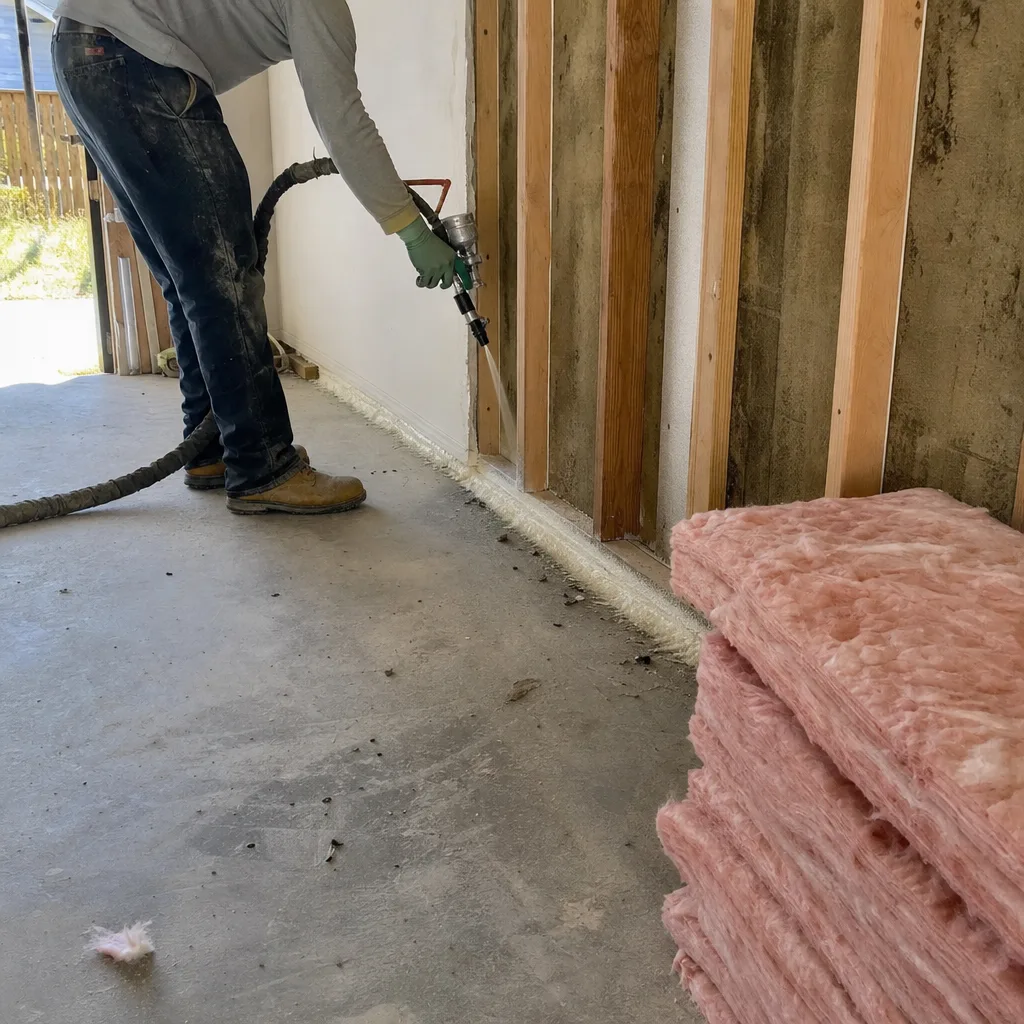
Call a design-build professional when your ADU project involves any of the following: existing structure conversion (garage, basement, or interior space), utility trenching over 50 feet, fire sprinkler integration, septic system interaction, or prefab/modular system specification. These are not homeowner-managed projects. The coordination failure risk exceeds any potential savings.
Ellery ADU Studio Lancaster offers free estimates in Lancaster. We also provide a Free Second Opinion on any written estimate already in hand - we’ll review the line items, flag omissions, and explain what the bid actually covers. Call (661) 528-5298 to schedule.
Frequently Asked Questions
Garage conversion ADUs in Lancaster typically run $145,000-$195,000 all-in, drawings through final inspection. New detached ADUs range $220,000-$340,000 depending on size, utility distance, and finish level. Junior ADUs and interior conversions fall between $85,000-$140,000. These ranges include permits, soils testing, utility trenching, and Title 24 compliance - the categories often omitted from initial bids. Call (661) 528-5298 for an exact quote on your specific property; estimates are free.
Under a properly structured fixed-price contract, no. At Ellery ADU Studio Lancaster, Haven Standard Clause 5 locks the scope at signing. If we missed a condition visible during our site evaluation, we absorb the cost. Price changes occur only for homeowner-requested scope changes, code changes after permit issuance, or concealed conditions that no reasonable site visit could reveal. These triggers are defined in writing before you sign.
We pull all permits as part of our design-build contract. The permit set is our core product, not an afterthought. You are not the permit holder of record; we are. This means we - not you - navigate plan check corrections, inspection scheduling, and final COO. This is the single greatest risk reduction in the design-build model.
From permit application to certificate of occupancy, a Lancaster garage conversion typically takes 6-9 months; a new detached ADU, 9-14 months. Design and permitting add 3-5 months before construction begins. These timelines assume a design-build model with coordinated drawing and permitting. Design-then-bid projects often add 3-6 months in correction and blame-cycle delays.
Yes, with proper specification and coordination. We work with prefab and modular systems from Cover, Dvele, Mighty Buildings, and other manufacturers, integrated within our single-contract design-build model. The manufacturer provides the unit; we provide foundation, utility connection, site prep, and permit coordination. The critical factor is manufacturer documentation that satisfies Lancaster’s wind, seismic, and energy code requirements - not all systems have this ready.
Under our 365-Day Done Right Promise, we make it right - in writing, before the project starts. This is not a vague satisfaction guarantee. It is a specific warranty tied to the stamped permit set: if the built condition deviates from the approved drawings, we correct it at our cost within one year of final inspection. Documented photo records from every visit support this claim with evidence, not memory.
The Bottom Line
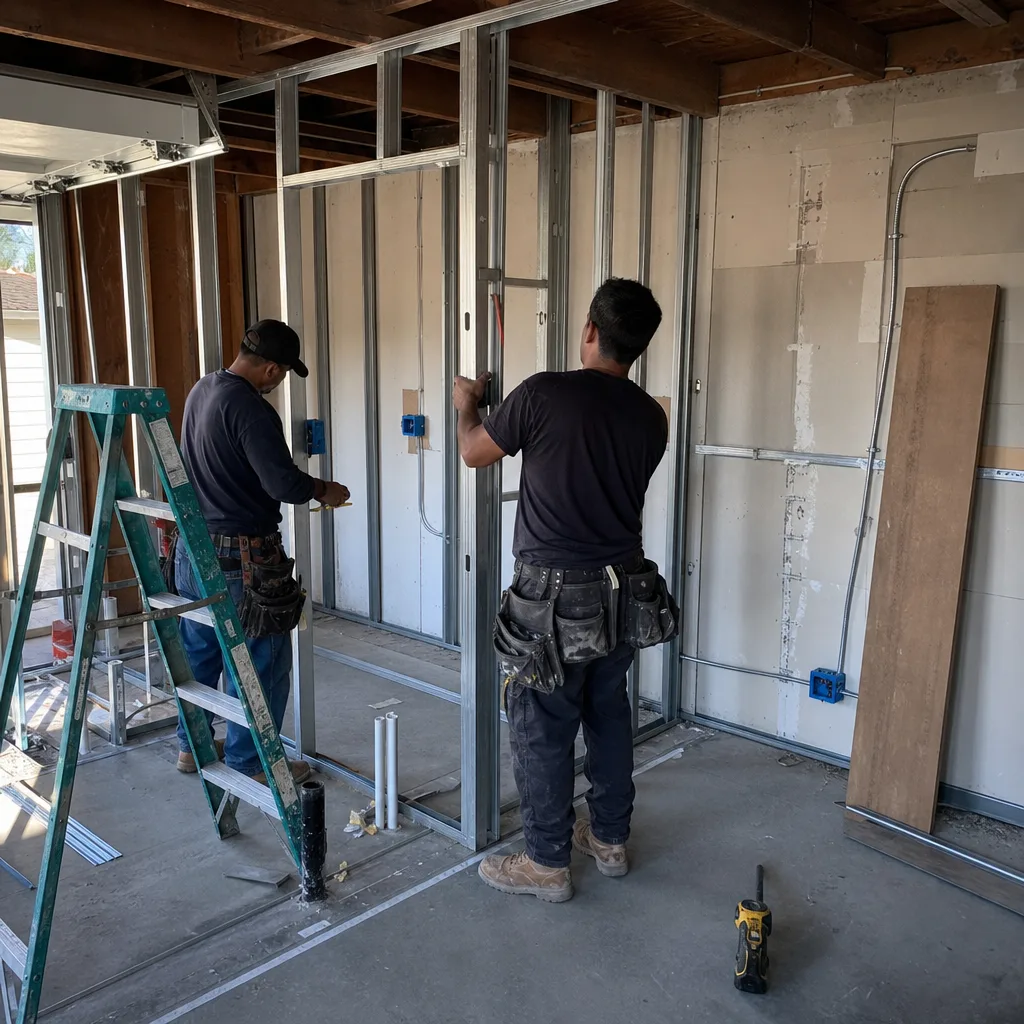
The contractor you hire in Lancaster matters less than the contract structure you choose. Design-then-bid creates a liability gap that costs homeowners $8,000-$18,000 in corrections and months of delay. Owner-managed projects place legal responsibility on homeowners who lack the bandwidth to coordinate trades through inspection conflicts. Design-build, with a single entity responsible for drawings, permits, and construction under a written fixed price, eliminates these failure modes. Verify permit history through LA County’s public portal. Demand itemized pricing that includes soils, trenching, sprinklers, and Title 24. Sign only a contract with scope tied to stamped drawings, defined change-order triggers, and inspection-milestone payments. The ADU contractor who can deliver all of this - with documentation, not promises - is the one worth hiring.
Written by Nadia Ellery, Owner at Ellery ADU Studio Lancaster, serving Lancaster since 2015.